|
Multicultural and Organization Development
Non-Governmental
Organizations and the Organization Development Cycle
(NGO OD)
Cycle
Non-Governmental Organizations (NGOs) are becoming increasingly
important for the range and kind of services they provide in a
rapidly changing environment. Models to help NGOs diagnose the
special organizational problems they have as they grow, develop,
and respond to changing needs can provide practical guidance when
consulting with these organizations. The literature points to
four important problem areas that NGOs face as they develop and
grow:
- Inefficiency
(They do less than they could)
An organization development (OD) consultant may offer help with
management information systems, technical assistance, board
and staff development, program quality assessment (TQM), and
supervisory and performance appraisal systems to deal with this
kind of problem.
- Ineffectiveness
(They do not do what they are supposed to do)
The kinds of organization development activities that may help
an NGO with this kind of problem include: strategic planning
to help focus their vision and mission, board and staff development,
program development and evaluation, budget planning, and so
on.
- Private
inurement (Illegitimate benefits for some)
Solving this kind of problem requires the board and/or other
stakeholder in the organization to address issues of equity
and accountability.
- Excessive
risk (Extreme vulnerability to the external environment)
Avoiding placing the organization in an extremely vulnerable
position requires a system of accountability measures such as
disclosure systems, reports that analyze and disseminate information,
and specific and public program outcome statements.
How a particular
NGO addresses these problems largely depends on its stage of development.
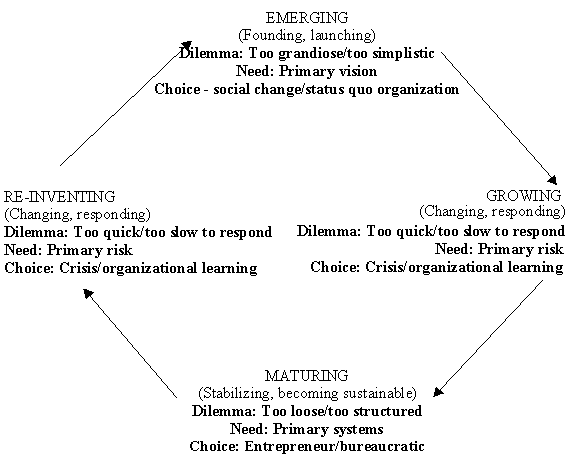
The model we have developed sees an NGO in a continual process
of moving through four stages in a cycle of growth. Each stage
presents different challenges to be managed by the executive,
the board, and the staff. The model helps an organization identify
its stage of development so it can address these problems in an
appropriate manner. The four stages of development of an NGO are
presented in FIGURE 1 (Click
here to see it).
The
NGO OD Cycle
STAGE
1: EMERGING
Characteristics
Emerging NGOs are those that are newly formed (or those that have
re-invented themselves and are launching themselves again, perhaps
with a different mission). Most NGOs at this stage are focused
on meeting a real need. In this environment they have some kind
of external support (which is key to their survival), are dependent
on a few key people/resources, have voluntary, none, or very few
staff, no budget, high energy and commitment, few systems in place,
and a small board and few leaders.
Dilemma
The typical dilemma is whether their vision is too grandiose
or too simplistic.
Need
The most important need of the NGO at this stage is for a primary
vision.
Choice
The organization has to make a choice as to whether it is committed
to social change or to what extent it is going to promote
the status quo. Once an organization has a vision, if it
is going to survive it needs to begin moving into the next stage,
growing, as soon as possible.
STAGE
2: GROWING
Characteristics
NGOs at this stage volunteers to accomplish some of the work of
the organization, have developed more programs, have some good
key people on the staff, have put a few organizational systems
in place, have a kind of expansive energy, and are involved in
increasing board and community action and support.
Dilemma
A typical dilemma is whether the organization will attempt to
do too much or too little.
Need
Growing NGOs have developed a primary vision of what they want
to achieve in society, but now need to translate that into a primary
task that can be implemented by the organization.
Choice
The organization faces the choice of whether its services are
going to be "niche" or multi-service.
STAGE
3: MATURING
Characteristics
NGOs at this stage have a budget and financial plans, have diversified
funding and support base, their energy is focused, they have a
sufficient number of staff, they provide professional development
opportunities for their staff, they have a history in their field
and a track record, an active and functioning board, and have
developed a reputation in the community.
Dilemma
A typical dilemma is whether the organization is too loosely
or too tightly structured.
Need
Maturing NGOs have a clear primary task but now need to develop
primary systems to implement their mission more effectively.
Choice
The organization faces the choice of locating itself on a continuum
that goes from more entrepreneurial to more bureaucratic.
The organizational systems developed should not be too slack or
too rigid.
STAGE
4: RE-INVENTING
Characteristics
A re-inventing NGO is an organization, which may have achieved
its primary task, or its task is no longer relevant in a changing
environment. NGOs at this stage have significant internal tensions,
have external pressures for change, and find themselves in a rapidly
shifting environment. Also, they may be re-structuring and reassessing
their board, staff, and community base and support.
Dilemma
A typical dilemma is that the organization at this stage may be
too quick or too slow to respond to environmental
changes.
Need
Its primary need is to identify the primary risk it faces
in terms of its relevance and survival as an organization.
Choice
The NGO faces the choice of functioning in a crisis mode
as it tries to adjust and adapt to a changing environment, or
trying to enter into a self- assessment mode that allows it to
"take stock" of where it is/should be, and develop continuous
mechanisms for feedback and organizational learning.
An
NGO may emerge out of the re-inventing process with an understanding
that it needs to respond to a different kind of social need. It
therefore moves into a more complex version of Stage 1 again (Emerging)
and begins the search for a new primary vision within the context
of its strengths and history.
The
model as a diagnostic tool
The
model has proved very useful as a diagnostic tool. Together with
a consultant, an organization can decide where it is in the cycle.
Then it can make an assessment of its primary need, choice, and
dilemma. Based on that assessment, appropriate organization change
interventions can be designed and implemented. Instead of using
standard intervention approaches that do not acknowledge the subtlety
and complexity of organizations in a continual process of change,
the challenge is to design specific interventions appropriate
for the stage of development they are in.
For
example, when Evangelina consulted with The Nigerian Trainers
Network, she assessed it at the emerging stage. An internal future
search/strategic planning process helped the members begin to
articulate their vision and develop short and long term goals
to direct their energy in a realistic manner. As they worked together
to produce a strategic plan, she gave them the following advice:
- Develop
a few key systems, not complicated offices and databases
- Focus on
enabling strong leadership and followership
- Hold on
to those aspects of the vision that have been identified as
"common ground"
As this organization
moves from the emerging stage into the growing stage, her recommendations
will change.
ref:
3194ngood
|